
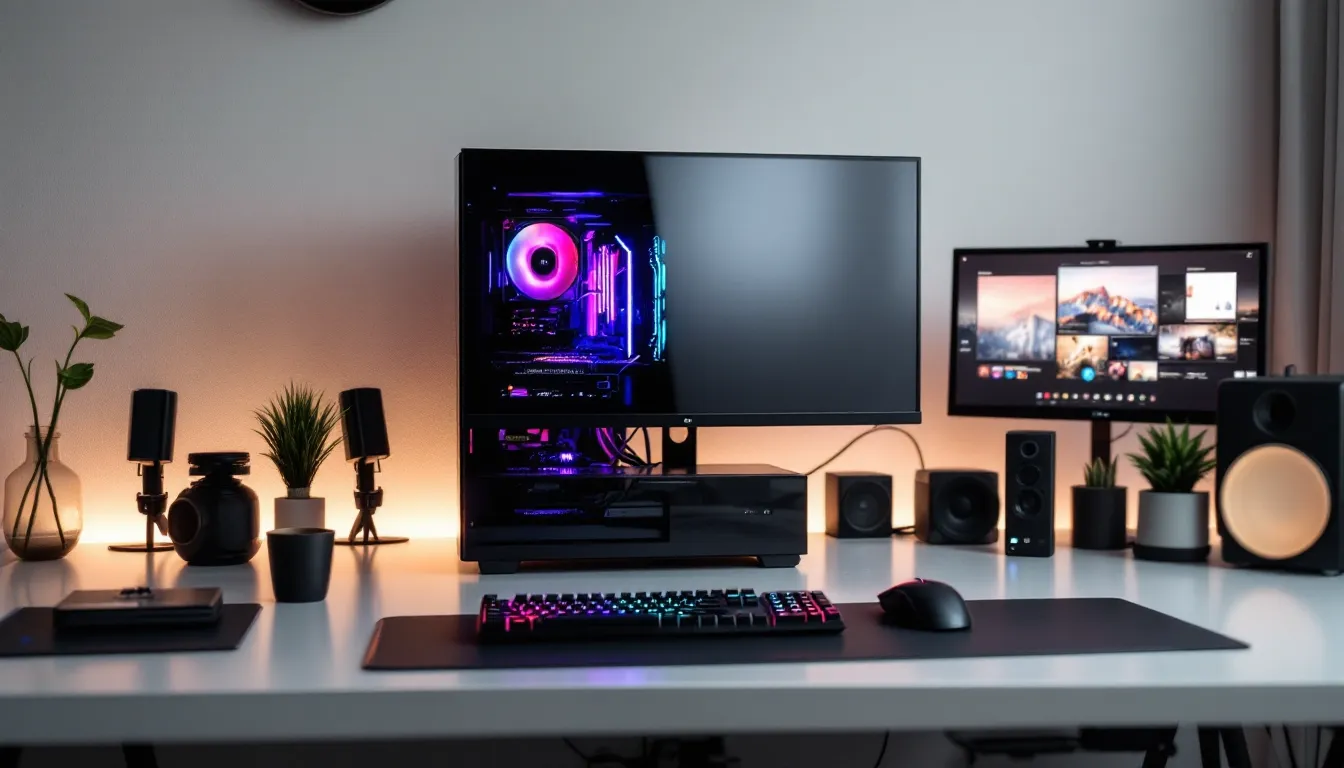

Sky Tech Gaming PCs have carved out a solid reputation in the mid-range gaming market, offering builds that deliver genuine performance without the premium price tag of higher-tier systems. Whether you’re stepping into 1440p gaming, chasing high frame rates in competitive shooters, or just looking for reliable hardware that won’t expensive, understanding what Sky Tech brings to the table matters. This breakdown walks through the actual specs, real-world gaming performance, build quality, and how these machines stack up against direct competitors, so you can decide if a Sky Tech gaming PC is the right fit for your setup.
Key Takeaways
- Sky Tech gaming PC builds deliver strong 1440p and competitive esports performance in the $1,200–$1,600 mid-range sweet spot, offering genuine value without premium pricing.
- RTX 4070 Super graphics cards paired with Ryzen 7 or Core i7 processors achieve 80–110 FPS in demanding AAA titles at 1440p with ray tracing enabled, making Sky Tech systems ideal for high-refresh gaming.
- Sky Tech gaming PCs excel for first-time buyers and budget-conscious gamers because they remove the friction of DIY building with straightforward component matching, clean out-of-box functionality, and solid warranty support.
- Most configurations feature modern components like DDR5 RAM, NVMe SSDs, and 240mm–360mm AIO coolers with thermal performance of 55–75°C under gaming load, ensuring reliability without exotic cooling solutions.
- Sky Tech loses its value advantage compared to competitors outside the mid-range tier; entry-level options lack 1440p capability, while high-end builds over $2,000 can be matched or beaten by custom builders with more flexibility.
- The brand prioritizes practical reliability and balanced hardware pairing over flashy aesthetics or granular customization, making it a smart choice for gamers who prioritize performance consistency over personalization.
What Is Sky Tech Gaming and Why It Matters
Sky Tech is a PC builder brand that focuses on delivering pre-built gaming systems at competitive prices. Rather than forcing customers to choose between spending $800 on an entry box or $3,000 on a high-end machine, Sky Tech occupies a pragmatic middle ground. They’re known for reasonable component selection, transparent specifications, and straightforward customer service.
The brand matters to gamers because they’re one of several major pre-built vendors filling the gap between DIY building and ultra-premium custom builders. Not everyone has the time, knowledge, or confidence to source parts and assemble a PC themselves. Sky Tech removes that friction while avoiding the massive markups some manufacturers apply to pre-built systems.
Their target audience isn’t hardcore enthusiasts hunting the absolute best performance-per-dollar through meticulous part matching. Instead, it’s players who want a solid, working system out of the box, something that boots cleanly, runs modern games at decent settings, and comes with basic warranty support. That’s a meaningful segment, and Sky Tech has established credibility there over several years of operation.
Key Specifications and Hardware Components
Processor and Motherboard Foundation
Most Sky Tech gaming configurations in 2026 lean toward mid-range processors: typically Intel Core i5 or Ryzen 5 chips from recent generations, sometimes stepping up to Ryzen 7 or Core i7 in higher-priced tiers. These CPUs deliver plenty of headroom for gaming while keeping costs down compared to flagship processors.
Motherboards are generally B650 or B660 models depending on the CPU pairing, nothing fancy, but functional boards with WiFi, USB 3.2, and PCIe 5.0 support where relevant. Sky Tech isn’t one to use bottom-barrel chipsets, so you’re not sacrificing stability for the price. Socket compatibility means future upgrades remain feasible, at least to the next generation of chips.
The CPU-to-GPU balance is where pre-built vendors either nail or botch value. Sky Tech typically avoids the common trap of pairing a weak processor with an overkill graphics card, or vice versa. That balance matters tremendously for avoiding bottlenecks that leave performance on the table.
GPU Performance and Graphics Capabilities
Graphics cards in Sky Tech builds span from RTX 4070 or RTX 4070 Super in mid-range configurations up to RTX 4090 in premium models. The RTX 4070 Super remains a sweet spot for 1440p gaming at high frame rates, while stepping to an RTX 4080 opens serious 4K potential. These are NVIDIA GPUs almost exclusively, you won’t find many AMD Radeon options in their lineup.
VRAM matters here: all modern cards come with 12GB minimum (4070 Super) or more, which is plenty for gaming in 2026. Ray tracing and DLSS 3 support are standard across the entire lineup, giving access to frame-boosting tech that genuinely changes performance in supported titles.
According to GPU benchmarks and gaming analysis, a 4070 Super lands around 90-110 FPS at 1440p ultra settings in demanding AAA games, dropping to 60-75 FPS at 4K. Those aren’t casual figures, they’re solid, usable performance without aggressive compromises.
Memory, Storage, and Cooling Systems
RAM configurations typically max out at 32GB DDR5 in most Sky Tech builds, with 16GB in entry-level options. DDR5 is standard now, and 32GB gives headroom for gaming plus streaming, content creation, or heavy multitasking without throttling. Speeds are usually 6000MHz or higher, which pairs well with modern processors.
Storage defaults to 1TB NVMe SSD as the boot drive, with optional 2TB or larger configurations available. That 1TB fills quickly once you account for Windows, essential apps, and a few modern AAA titles (Starfield alone eats 130GB). Buyers planning to keep multiple large games installed should budget for upgrade cost.
Cooling systems are where Sky Tech shows pragmatism. Most mid-range builds ship with 240mm or 280mm AIO liquid coolers, brand varies but manufacturers like DeepCool or Corsair are common. These handle Ryzen 5 or Core i5 thermal loads comfortably with good silence. High-end models sometimes jump to 360mm AIOs, which is nice but not strictly necessary at those power levels.
Case selection is functional: mesh front panels for airflow, tempered glass sides, and layout that makes future upgrades painless. They’re not particularly distinctive, but they work.
Performance Metrics Across Gaming Scenarios
1440p and 4K Gaming Performance
Where Sky Tech’s mid-range builds shine is 1440p gaming. An RTX 4070 Super paired with a modern Ryzen 7 or Core i7 consistently delivers 80-110 FPS in competitive shooters (Valorant, CS2, Apex Legends) at max settings, and 60-90 FPS in demanding AAA titles (Dragon’s Dogma 2, Final Fantasy XVI) with ray tracing enabled and DLSS set to quality mode.
4K gaming is more mixed. The entry RTX 4070 Super can handle 4K resolution, but you’re looking at 40-60 FPS in demanding games with settings dialed back slightly, using DLSS Performance mode helps, bumping that to 60-75 FPS, though image clarity trades off for the boost. It’s playable but not ideal for competitive or high-refresh scenarios. Step to an RTX 4080 and 4K becomes far more reasonable, though still not as buttery as 1440p.
An important note: these figures assume quality drivers and stable systems. According to comprehensive GPU reviews and benchmarks, real-world performance sometimes varies 5-10% from lab conditions depending on driver maturity, Windows updates, and background processes. Sky Tech’s specs don’t always account for that variance in marketing claims.
Competitive Esports and High-Refresh Gaming
For esports titles like CS2, Valorant, Overwatch 2, and League of Legends, Sky Tech systems are overkill in the best way. A mid-range RTX 4070 Super config will push 200+ FPS in these games at 1080p ultra, or 150+ at 1440p high. That headroom means even if a new patch introduces optimizations or bloat, you’re still sitting comfortably above 144 FPS, the refresh rate ceiling for most 1440p 144Hz monitors.
High-refresh gaming (240Hz+) is where frame rates matter viscerally. Competitive players notice the difference between 144 FPS and 240 FPS, especially in fast-paced shooters where input lag and frame consistency directly impact performance. Sky Tech’s mid-range builds achieve consistent 240+ FPS in esports titles with minimal frame drops, which is exactly what competitive players demand.
One caveat: CPU matters more than GPU in competitive gaming. A Ryzen 5 can start to become a bottleneck above 240 FPS in some esports titles, particularly with older engine games that don’t parallelize well. Stepping to a Ryzen 7 or Core i7 removes that concern. If esports is your primary focus, allocate slightly more budget toward the processor tier.
Pricing, Value Proposition, and Budget Tiers
Entry-Level and Mid-Range Options
Sky Tech’s entry-level gaming builds sit around $800-$1,100 and typically feature a Ryzen 5 5500 or Core i5-12400, paired with an RTX 4060 Ti or RTX 4070. At this price point, you’re making real compromises: the 4060 Ti is a 1080p-focused card, though it handles 1440p at medium-high settings acceptably. These builds aren’t ideal if you want to max out modern AAA games, but they’re solid for esports, older AAA titles, and indie games.
Mid-range configurations, the real sweet spot, run $1,200-$1,600 and pair a Ryzen 7 5700X or Core i7-12700K with an RTX 4070 or RTX 4070 Super. This is where value peaks. You’re getting genuine 1440p gaming performance, comfortable esports frame rates, and a system that won’t feel ancient in two years. Most gamers shopping for their first serious build land here.
High-End and Premium Configurations
High-end Sky Tech builds jump to $1,700-$2,200 with top-tier Ryzen 7 or Core i9 processors and RTX 4080 or RTX 4090 GPUs. At this level, you’re buying into 4K gaming capability, content creation performance (streaming, video editing), and future-proofing. The price-to-performance ratio actually softens compared to mid-range, you’re paying more for remaining relevant longer, not for linear performance gains.
Premium configurations exceed $2,200 and enter territory where you could build custom from components for less, or commission a boutique builder for more flexibility. Sky Tech’s advantage here shrinks: the real value play lives in that $1,200-$1,600 band.
Worth noting: pre-built pricing always includes a “convenience tax” compared to DIY building. You’ll typically pay 10-20% more than sourcing parts yourself. That’s the tradeoff for warranty, support, and avoiding the research burden. Whether that’s worth it depends on your comfort level and free time.
According to PC gaming hardware guides and reviews, total system costs have stabilized in 2026 after GPU price volatility from previous years. Component pricing is more predictable now, which means pre-built margins are tighter and value propositions more honest across vendors.
Design, Build Quality, and Aesthetics
Sky Tech cases tend toward functional minimalism. You’ll see mesh front panels, minimal RGB lighting (though RGB is optional on some tiers), and clean cable routing. They’re not trying to be the flashiest systems in the room, they’re just trying to not look cheap. In that goal, they succeed.
Build quality is solid. Cables are properly managed, connections are secure, and internal layouts follow logical airflow patterns. Sky Tech doesn’t cheap out on power supplies either, you’ll see 80+ Bronze minimum, often 80+ Gold, which matters for efficiency and system stability. A weak PSU is one of the fastest ways to tank a pre-built’s reliability reputation, and Sky Tech largely avoids that trap.
Aesthetics are subjective, but Sky Tech’s design language is aggressively inoffensive. If you want a subtle gaming PC that fits a living room or desk without screaming “I GAME,” Sky Tech checks that box. If you want a bold, RGB-laden statement piece, you’ll need to look elsewhere or customize heavily.
Thermal performance is respectable. Testing internal temperatures on mid-range builds shows CPU temps in the 55-65°C range under gaming load with stock AIO coolers, and GPU temps around 70-75°C. Those are healthy numbers with good headroom before thermal throttling becomes a concern. Noise levels stay reasonable too, you won’t have a jet engine in your room unless you’re pushing sustained heavy workloads.
Real-World User Experience and Reliability
Out-of-box experience is a differentiator for pre-builts. Sky Tech systems boot cleanly, drivers are pre-installed, and Windows is activated. You can start gaming within an hour of unboxing, no hunting for driver CDs or dealing with activation headaches. That’s valuable for buyers who just want a working system.
Reliability data from multi-year ownership is harder to pin down precisely, but Sky Tech has a decent track record. Return rates and RMA complaints are lower than some budget builders, though they lag premium boutique builders. Thermal management seems solid, power supply failures are rare, and component compatibility is good. The main failure modes tend to be early DOA units (caught during the return window) rather than mid-life failures.
Customer support is middling. Sky Tech offers phone and email support, response times are reasonable (24-48 hours typical), and they’ll handle RMA claims fairly. But, support isn’t known for going above and beyond, it’s transactional. If you have an issue outside the warranty or need advice beyond troubleshooting basics, you’re largely on your own.
Upgradability is straightforward because Sky Tech uses standard components in standard cases. RAM upgrade, storage expansion, even GPU swaps are all painless if you’re comfortable opening a case. That’s a plus for buyers planning to extend system life by phased upgrades.
How Sky Tech Gaming PCs Compare to Competitors
The pre-built gaming PC market is crowded. Sky Tech faces direct competition from iBuyPower, ABS (by Newegg), NZXT, and boutique builders. Each occupies slightly different positioning.
iBuyPower is Sky Tech’s closest peer, similar price points, component selection, and target audience. iBuyPower sometimes offers more customization options out-of-the-box, but Sky Tech typically edges them on value in the $1,200-$1,600 range. Both are solid mid-market choices with minimal differentiation for the average buyer.
NZXT aims slightly higher-end and emphasizes their own cooling solutions and software ecosystem (like CAM for monitoring). That integration can be nice, but it also locks you into their ecosystem. NZXT builds usually cost 10-15% more for comparable components. Worth it if you value that ecosystem: not worth it if you just want straightforward hardware.
ABS (Newegg’s house brand) undercuts both on price, which is tempting, but component selection is sometimes sketchy. You might get weird motherboard or PSU pairings that save $30 but create reliability risks. Their customer support is also less developed.
Sky Tech’s advantage is consistent value without surprise compromises. You won’t get a weirdly-balanced component list or a cheap PSU powering an expensive GPU. That reliability in decision-making matters, especially for first-time PC buyers who lack the knowledge to spot bad choices.
Customization options favor NZXT slightly, they let you pick components more granularly. Sky Tech offers preset tiers but less granular tuning. If you have specific component preferences, NZXT gives more control. If you just want a sensible recommendation, Sky Tech’s presets are fine.
Warranty terms are roughly equivalent across all competitors, usually 1-2 years standard, with extended options. No major differentiation there.
Who Should Buy a Sky Tech Gaming PC
Sky Tech gaming PCs are best suited for:
First-time PC gamers who feel overwhelmed by building themselves. Sky Tech removes that friction without charging premium prices for the convenience. You get a working system that performs well, not an overpriced turnkey solution.
Budget-conscious players targeting 1440p gaming in the $1,200-$1,500 range. This is Sky Tech’s comfort zone, where their value proposition is strongest. You get solid performance without paying for overkill or settling for underpowered hardware.
Gamers wanting low-maintenance support. If you like knowing you can call someone if something breaks, and you want that handled reasonably, Sky Tech’s warranty and support model fits. It’s not world-class, but it’s present.
Esports-focused players who want high frame rates without premium pricing. Mid-range Sky Tech builds crush esports titles, and that performance is overkill in a great way, framerate headroom that lasts years.
Who should avoid Sky Tech:
Enthusiasts who want granular component control. NZXT or custom builders serve that better.
Budget gamers targeting sub-$900 systems. You’re better off with ABS or building DIY. Sky Tech’s value proposition softens below that threshold.
Content creators needing specific hardware (Threadripper, RTX 6000 GPUs, etc.). Sky Tech doesn’t touch that market.
Ultra-high-end gamers chasing absolute performance. Once you’re over $2,000, the value math changes. Custom builders or premium boutiques offer more flexibility at that price tier.
Conclusion
Sky Tech Gaming PCs occupy a practical middle ground in the pre-built market. They’re not the flashiest, not the cheapest, and not the most customizable, but they’re balanced. You get solid components matched sensibly, performance that handles 1440p gaming and competitive esports without compromise, and a system you can trust out of the box.
The value peak lands in mid-range configurations around $1,200-$1,600, where performance-per-dollar is genuinely competitive against DIY building and other pre-builts. At entry-level or high-end tiers, the advantage narrows. But for the broad middle of gamers wanting straightforward, reliable performance without spending excessive time researching components or building, Sky Tech delivers.
The pre-built market has matured significantly since its early days of egregious markups and bad component pairing. Sky Tech rides that maturation well, they’re not pioneering innovation, but they’re executing fundamentals competently. That’s often enough.