
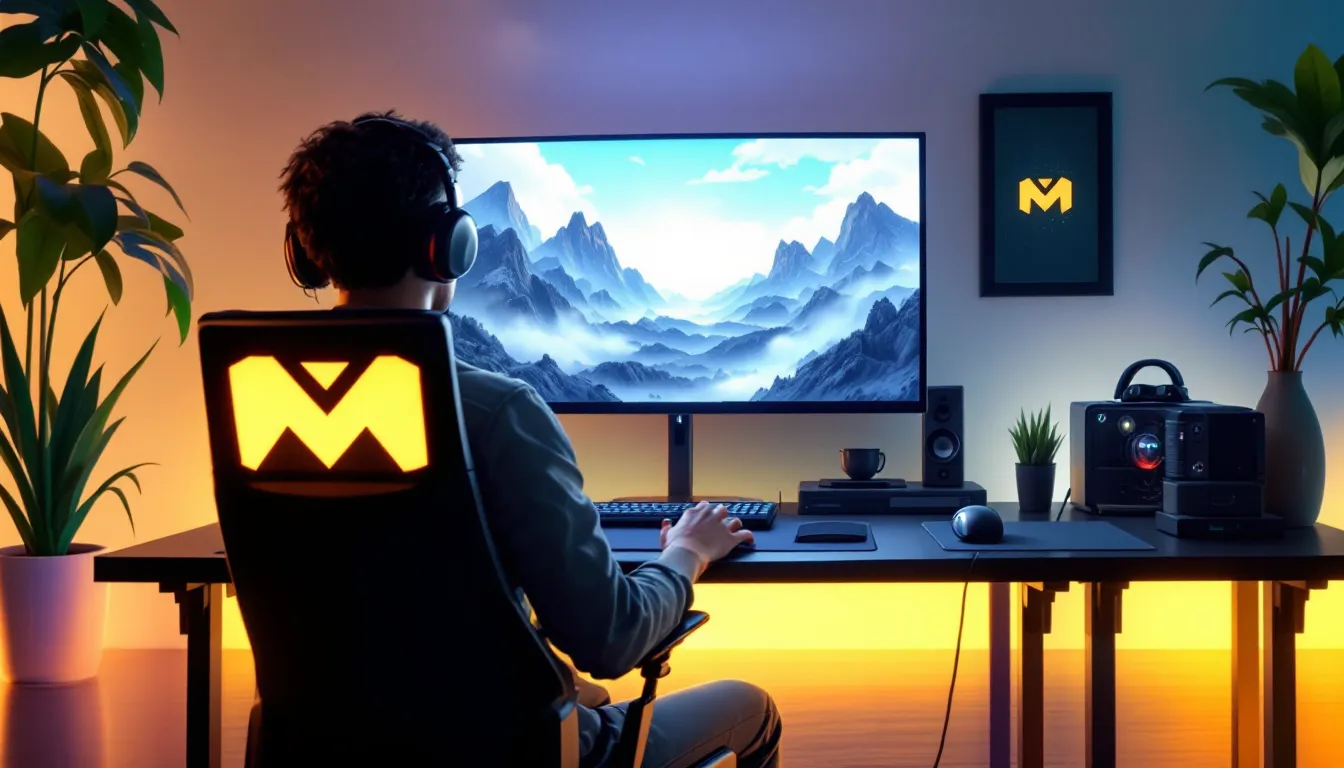

Gaming technology in 2026 isn’t just about prettier graphics, it’s fundamentally changed how players experience their favorite titles. From sub-millisecond response times to AI-driven upscaling that maintains visual fidelity while crushing frame rates, modern gaming tech has become the invisible hand that separates a frustrating session from an unforgettable one. Whether you’re a competitive esports player chasing every advantage or a casual gamer who wants their couch sessions to feel cinematic, today’s innovations touch every aspect of the experience. The gaming tech benefits you get today, lower latency, faster load times, immersive audio, aren’t luxuries anymore: they’re expectations. Understanding what these advancements actually do and how they matter to your specific gaming setup is the key to making smart upgrade decisions and staying competitive.
Key Takeaways
- Modern gaming tech benefits like sub-millisecond response times and AI-powered upscaling have transformed from luxury features into essential expectations that directly impact competitive performance and immersion.
- GPUs and CPUs in 2026 prioritize efficiency and AI upscaling over raw power, allowing mid-range systems ($1,200–$1,500) to deliver 1440p gaming at 80–120 FPS, making high-performance gaming more accessible than ever.
- Ray tracing and advanced spatial audio have become practical standards on current-generation consoles and PCs, creating more realistic lighting, dynamic shadows, and three-dimensional sound that enhance both competitive advantage and immersion.
- Esports-grade hardware—including 35,000 Hz polling rate mice, optical keyboards, and low-latency networking—proves that gaming tech innovations can measurably improve player performance, with pros gaining competitive edges through millisecond-level optimizations.
- Mobile gaming has reached a performance inflection point, with flagship smartphones now running Unreal Engine 5 titles at 60–120 FPS with full ray tracing, proving that gaming tech benefits extend beyond traditional PC and console platforms.
What Is Gaming Tech and Why It Matters to Modern Gamers
Gaming tech encompasses the hardware, software, and network infrastructure that directly impact how games run and feel. It’s not just GPUs and CPUs, it includes monitors with variable refresh rates, input devices with microsecond-level polling rates, sound systems that place audio in three-dimensional space, and cloud services that handle game streaming and matchmaking. The reason this matters is simple: a 10ms reduction in input lag can be the difference between a ranked win and a loss. A 20 FPS jump can transform a stuttery, unplayable experience into something smooth and responsive. Gaming tech benefits compound, a better GPU doesn’t just mean higher frame rates: paired with an efficient driver update, it might also mean lower temperatures and quieter cooling fans. The ecosystem has matured to the point where individual improvements stack up into tangible quality-of-life changes across every genre. For competitive players, gaming tech is literally an investment in reaction time and mechanical advantage. For single-player enthusiasts, it’s the difference between immersion and distraction.
Performance Benefits: Faster Load Times and Higher Frame Rates
Modern gaming tech has solved or drastically reduced two of gaming’s oldest pain points: wait times and framerate inconsistency. Load times have shrunk from minutes to seconds thanks to NVMe SSDs, proprietary decompression architectures, and optimized engine streaming. Frame rate stability, hitting consistent 60 FPS, 120 FPS, or higher, is now achievable across a much broader range of hardware thanks to smarter power management and driver optimization. The practical benefit is that you spend less time staring at loading screens and more time playing. Your animations feel smoother, your aim feels snappier, and your overall session feels less interrupted.
GPU and CPU Advancements
GPU architecture has shifted from raw power toward efficiency and feature acceleration. NVIDIA’s latest generation (RTX 50 series) and AMD’s RDNA 4 focus on AI-powered upscaling via DLSS 4 and FSR 3, which intelligently reconstruct high-resolution images from lower-resolution renders. This means you can run a game at 1440p with ray-traced reflections, FXAA anti-aliasing, and volumetric fog while the GPU only renders 25–40% of the pixels natively. The result: 60–100+ FPS in games that previously demanded $2,000+ systems for playable frame rates.
CPU improvements center on core efficiency and clock speeds. 2026’s top-tier processors (Intel Core Ultra Gen 4, AMD Ryzen 7 9000 series) deliver 14–16 cores with sustained 5.5+ GHz clocks, which directly translates to better frame rates in CPU-heavy titles like Tekken 8, Star Citizen, and Cities: Skylines 2. Multi-threaded games no longer see performance cliffs at high player counts or complex physics simulations.
Real-World Performance Gains Across Platforms
On PS5 and Xbox Series X
|
S, performance modes now consistently deliver 120 FPS at 1440p, with fidelity modes maintaining locked 60 FPS at native 4K. A year ago, this would’ve been considered impossible for mid-generation consoles. On PC, a $800 RTX 4070 GPU paired with a mid-range CPU can push 1440p at 100+ FPS in modern AAA titles with maximum settings. That same setup in 2020 would’ve been pushing 80 FPS on medium-to-high settings.
Launch speeds exemplify this: Final Fantasy VII Rebirth loads in 8 seconds on PS5 with the latest system software. On PC, games installed on Gen 4 NVMe drives (like Samsung 990 Pro) boot from main menu to gameplay in under 5 seconds, compared to 30–45 seconds on SATA SSDs from just three years prior.
Graphics and Visual Quality Enhancements
Visual fidelity has reached a plateau in terms of raw polygon counts and texture resolution, you can’t see much improvement going from 8K textures to 16K at normal viewing distances. Instead, 2026’s graphical advancements focus on lighting realism, material accuracy, and environmental responsiveness. These changes are more subtle than a texture swap but profoundly affect immersion.
Ray Tracing and Lighting Innovations
Ray tracing simulates how light bounces realistically through a scene, replacing the flat, pre-baked lighting that dominated games for decades. By 2026, ray tracing isn’t a performance luxury, it’s becoming standard even on mid-tier hardware thanks to dedicated ray-tracing cores on GPUs and optimizations in game engines. Games like Cyberpunk 2077: Phantom Liberty now support full ray-traced global illumination (all light in the scene is computed in real-time), meaning that neon sign reflections on wet pavement or sunlight bleeding through office windows behave physically accurately.
The gaming tech benefits are immediate: environments feel lived-in because lighting responds naturally to player actions and time of day. A flare grenade doesn’t just appear bright, it actually illuminates the surrounding area dynamically, casting realistic shadows. This is more impactful than you’d think for immersion and even competitive clarity (seeing enemy silhouettes against dynamic light sources is harder than against static lighting).
Techniques like NVIDIA RTX Global Illumination and AMD’s Ray Accelerators have made this feasible without cutting frame rates in half. Newer titles blend real-time ray tracing with pre-computed lighting for the best of both worlds: realistic reflections where it matters, steady 60+ FPS everywhere.
Resolution and Texture Improvements
Native resolution targets have shifted from 1080p (last generation’s baseline) to 1440p and 4K as the minimum expectation for high-end hardware. More importantly, upscaling technologies have matured to where 1440p upscaled to 4K via DLSS or FSR looks virtually identical to native 4K while maintaining 2–3x better frame rates.
Texture budgets (total VRAM dedicated to surface details) have grown with GPU memory. Mid-range cards now ship with 12 GB VRAM, high-end cards with 24 GB. This allows developers to ship games with 2–4K textures across all surfaces, meaning close-up details on character faces, weapon finishes, and environmental props remain crisp and detailed even at maximum zoom or magnification in sniper scopes.
Gaming Hardware: PC, Console, and Mobile Tech Breakthroughs
The hardware landscape in early 2026 shows a clear divergence: PCs for maximum performance, consoles for consistency and value, mobile for convenience. Each platform has seen meaningful tech breakthroughs that make each category viable depending on your priorities.
Next-Generation Consoles and Features
PS5 Pro and Xbox Series X
|
S Refresh (rumored late 2026/early 2027) are expected to deliver 2–3x the GPU performance of current-gen consoles through process node improvements and architectural optimizations. Neither needs to increase power consumption dramatically because efficiency gains are significant. The practical impact: games that currently target 1080p at 120 FPS or 1440p at 60 FPS will shift toward 1440p at 120 FPS or native 4K at 60 FPS with ray tracing fully enabled.
Console-specific benefits include SSD innovations (proprietary compression algorithms that decompress game assets faster than PCIe speeds would suggest) and specialized AI accelerators for upscaling and frame generation. PlayStation’s Tempest 3D audio also benefits from dedicated hardware, making spatial audio processing so efficient that games can simulate multi-speaker surround with just stereo headphones.
High-End Gaming PCs and Accessibility
PC gaming’s advantage, modularity and future-proofing, has never been stronger. In 2026, the high-end is dominated by RTX 5090 and Radeon RX 8900 XT cards, which push 200+ FPS at 4K with full ray tracing and DLSS 4. But the real story is mid-range accessibility: a $1,200–$1,500 PC build now delivers performance that $3,000+ systems achieved just 18 months ago.
According to recent GPU benchmarks and gaming PC hardware analysis, a system pairing an RTX 4070 Super with a Ryzen 5 9600X crushes modern AAA titles at 1440p high settings, achieving 80–120 FPS depending on the game. That’s mainstream gaming performance, not enthusiast-tier. DDR5 memory is now cheap enough to be standard even in budget builds, and frame generation (where AI creates interpolated frames between real renders) has become a stable feature in most major engines.
Mobile Gaming Tech Revolution
Mobile gaming in 2026 has crossed an inflection point: flagship phones (iPhone 16 Pro, Samsung Galaxy S25 Ultra) now carry GPUs rivaling high-end integrated graphics from just three years ago. Qualcomm’s Snapdragon 8 Elite and Apple’s A18 Pro can handle Unreal Engine 5 games with full ray tracing at 60 FPS in 1440p resolution on a 6.5-inch screen.
The gaming tech benefits extend beyond raw performance: better thermal management (vapor chambers and multi-layer copper spreaders) means sustained high frame rates without throttling, and improved mobile OS scheduling allows games to monopolize GPU cycles without affecting system responsiveness. Genshin Impact now runs at stable 120 FPS on flagship Android and iOS devices, which would’ve been unthinkable in 2023.
Cloud gaming (Xbox Game Pass Ultimate’s Cloud Play, PlayStation Plus Premium Deluxe, NVIDIA GeForce Now) has also matured. Latency is now 40–80ms for most players (competitive but playable), and compression algorithms have improved to the point that high-bandwidth games stream with minimal artifacting. WCCFTech frequently covers hardware breakthroughs and leaks, providing insights into upcoming mobile and console tech before official announcements.
Esports Tech: Competitive Gaming Advantages and Tools
Esports has become a proving ground for gaming tech innovation. Competitive players operate at the margins of milliseconds and frame drops, making hardware and software optimizations visible in win rates and tournament placements.
Input Devices and Precision
Gaming mice have standardized on 8,000 Hz polling rates (8 millionths of a second between movement reports to the PC) as baseline, with some flagships like the Finalmouse UltralightX and Razer Viper V3 pushing 35,000 Hz. The practical effect: your aim is registered almost instantaneously, reducing the gap between your hand movement and on-screen crosshair placement from 1–2 frames down to 0.5 frames or less. In a fast-paced competitive shooter, that’s a meaningful advantage.
Mechanical switches in gaming keyboards have evolved similarly. Linear switches (no tactile bump) dominate competitive games for lower actuation times (~45ms), while optical switches eliminate membrane tolerance issues, delivering frame-perfect consistency. Professional players often use custom-mapped keys to minimize hand movement distance, moving ability casts to thumb keys rather than distant pinky keys, for instance.
Mousepads have also benefited from materials science: glass or hybrid cloth surfaces reduce friction inconsistency, meaning micro-adjustments in aim feel predictable. Professional players often use XL pads (12″ x 24″) to reduce the need for multiple swipes in games like Counter-Strike 2 or Valorant.
Networking and Low-Latency Solutions
Network latency (ping) is arguably more critical than frame rate in competitive online games. A 50ms ping with 60 FPS is worse than 200ms ping with 240 FPS from a competitive standpoint, because network latency directly impacts the server’s view of your actions. Esports venues have solved this by deploying dedicated gaming networks with optimized routing and DDoS protection. Professional tournaments ensure players get single-digit ping and <:1% packet loss by running on fiber networks and placing servers in-house.
For home players, gaming hardware reviews from Tom’s Hardware often benchmark networking gear for esports readiness. WiFi 6E routers with QoS (Quality of Service) prioritization can achieve 10–15ms latency over wireless, matching wired connections for most competitive titles. ISP-level solutions like dedicated gaming VPNs (ExitLag, NoPing) use proprietary routing to bypass congested internet backbone routes, often reducing ping by 20–100ms depending on region and ISP.
Frame generation (NVIDIA’s DLSS Frame Generation, AMD’s FSR 3 Frame Generation) is becoming competitive-viable as well. While pros were initially skeptical of AI-generated frames, recent tournaments (including Counter-Strike 2 competitive brackets) have greenlit frame generation for 240+ FPS play. The latency benefit of 240 FPS with interpolated frames often outweighs concerns about frame consistency.
Immersive Gaming Technologies
Beyond traditional visual and performance improvements, immersive tech is redefining how players experience games by adding spatial dimensions and sensory feedback.
Virtual Reality and Augmented Reality
VR gaming in 2026 has moved past the novelty phase. Standalone headsets like the Meta Quest 4 and upcoming Apple Vision Pro gaming editions deliver 4K resolution per eye, inside-out tracking without external sensors, and wireless gameplay via WiFi 6E. That means no wires, no base stations, and full 360-degree movement. The games have matured too: Half-Life: Alyx established VR as a storytelling medium, and 2025–2026 releases like Arizona Sunshine 2 and Batman: Arkham Shadow deliver AAA-quality narratives in VR.
The gaming tech benefits of VR are profound: your sense of scale, spatial awareness, and immersion are fundamentally different than on a 2D screen. A distant enemy in Half-Life: Alyx feels genuinely distant because your brain processes depth naturally. Reloading a weapon requires you to grab a magazine from your chest, which is more intuitive and memorable than pressing ‘R’.
Augmented reality gaming (overlaying digital content on the real world via phone camera or AR glasses) remains niche but promising. Pokémon GO proved the concept works at scale. Incoming AR glasses from Meta and other companies could unlock location-based gaming and real-world puzzle-solving that blend physical exploration with digital gameplay.
Audio Technology and Spatial Sound
Spatial audio (3D positional sound) has become standard in competitive and story-driven games. Technologies like Dolby Atmos for Gaming, Windows Sonic, and PlayStation Tempest 3D place audio sources around the player in three-dimensional space. In practice: footsteps sound like they’re coming from above and behind you (in VR shooters), or an enemy voice comes from upper-left (in competitive multiplayer). This isn’t just immersive, it’s tactically useful. A skilled player can locate an enemy by sound alone in games like Counter-Strike 2.
High-end gaming headsets now feature custom-tuned drivers with frequency responses optimized for gaming (emphasizing footsteps and voice callouts over music). Wireless headsets with dedicated USB dongles (like SteelSeries Nova Pro and SCUF H1 Headset) maintain 2.4 GHz latency-free audio while supporting multi-sensory feedback through haptic transducers in the ear cups.
The gaming tech benefits are measurable: teams with spatial audio training report improved enemy localization rates of 15–25%, directly correlating with higher win rates in competitive tournaments. For story-driven games, spatial audio makes cinematic moments hit harder, a helicopter flying overhead in GTA VI or environmental ambiance in Baldur’s Gate 3 feel three-dimensional and immersive.
Future Trends: What’s Next for Gaming Tech
Looking ahead to 2026 and beyond, several trends are crystallizing:
AI-Powered Game Design: Procedural generation, NPC behavior, and dynamic storytelling driven by AI will allow massive, hand-crafted-feeling worlds without the decade-long development cycles. Star Citizen and similar titles are already experimenting with AI-assisted character dialogue and quest generation.
Real-Time Ray Tracing as Standard: By 2027, full real-time ray tracing (global illumination, reflections, shadows) will be expected in AAA titles, not a checkbox feature. This requires mid-range hardware capable of 200+ ray-traced rays per frame, which current generation hardware is approaching.
Quantum-Assisted Game Simulation: Quantum computers, while still in their infancy for gaming, could simulate complex physics (water, cloth, particle systems) orders of magnitude faster. This remains speculative, but test implementations show promise for 2027–2029 adoption.
Brain-Computer Interfaces: Valve, Neuralink, and academic labs are exploring BCIs for gaming control. This is early-stage, think: gaze-tracking and thought-based ability activation. Adoption for mainstream gaming is likely 3–5 years away, but esports teams are already testing prototypes.
Modular Console-PC Hybrids: Future hardware may blur the line between PC and console, with upgradeable GPU and CPU modules, unified game libraries, and cross-platform progression. This would combine PC flexibility with console ease-of-use.
The core trend across all of these: gaming tech is moving toward transparency. You shouldn’t think about frame rendering, latency compensation, or upscaling algorithms, they should just work invisibly in the background, leaving you free to focus on the experience. By 2026, that’s largely achieved. By 2027–2028, it’ll be the bare minimum expectation.
Conclusion
Gaming tech in 2026 is no longer a luxury layer on top of core gameplay, it’s woven into every aspect of the experience. Whether it’s the 120 FPS you’re hitting in your favorite competitive title, the ray-traced reflections that make story-driven games feel cinematic, or the low-latency networking that keeps you competitive in esports, modern gaming tech benefits are tangible and measurable.
The convergence of efficient GPUs, optimized software, smarter AI upscaling, and better networking infrastructure means that gaming quality is more accessible than ever. You don’t need a $4,000 system to experience visuals that would’ve seemed cutting-edge five years ago. At the same time, if you do invest in high-end hardware, the returns are real: faster load times, better frame consistency, richer visual experiences, and competitive advantages that directly impact your performance.
The trajectory is clear: gaming tech will continue to optimize for efficiency, immersion, and responsiveness. The question isn’t whether your games will get better, they will. The question is which platform, hardware tier, and tech ecosystem makes sense for your goals and budget. By understanding what each piece of modern gaming tech actually does, you can make informed choices instead of chasing specs or falling for marketing hype.